Lean Bulk Guide: Build Muscle With Less Fat Gain
Set calories, protein, training, and progress checks for a controlled muscle-gain phase.
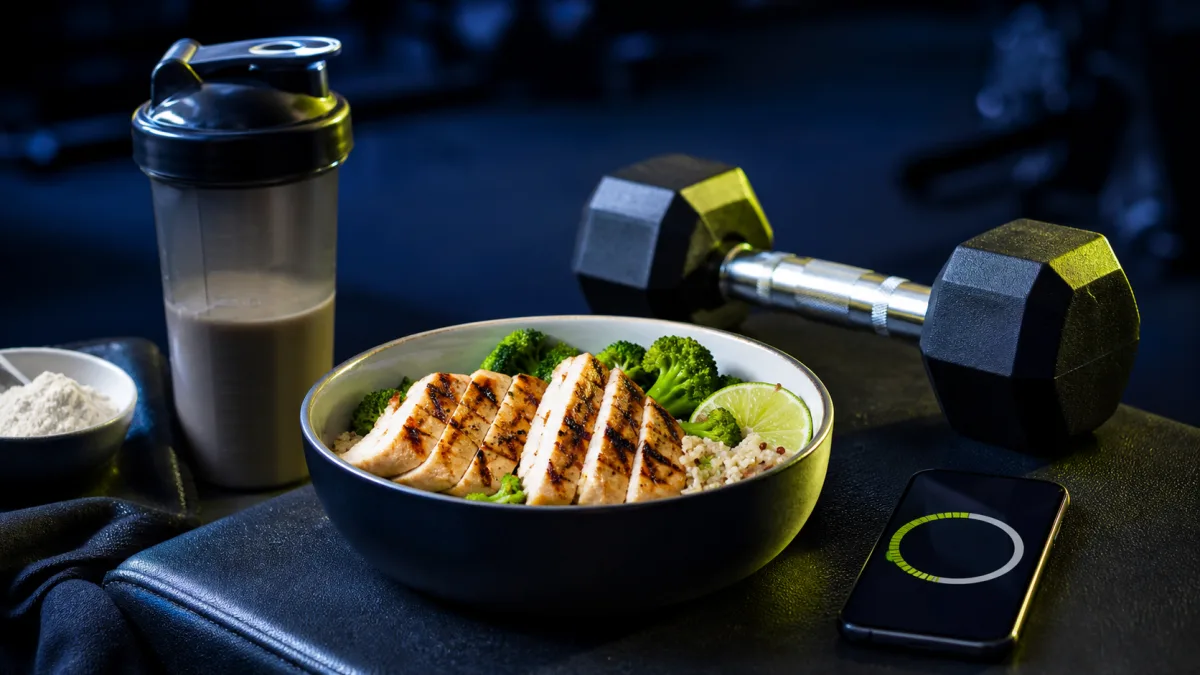
A lean bulk is a muscle-gain phase built around a small calorie surplus and measurable training progress. It is not a promise that every pound gained will be muscle. It is a way to provide enough energy for growth without treating rapid scale gain as success.
Set a modest calorie surplus
Start around 5–10% above maintenance. If maintenance is 2,600 calories, an 8% surplus is roughly 2,810 calories. The lean bulk calculator will find your personalised surplus from your TDEE, and the TDEE calculator can establish your maintenance if you don’t have it yet.
| Maintenance | 5% surplus | 10% surplus |
|---|---|---|
| 2,200 | 2,310 | 2,420 |
| 2,600 | 2,730 | 2,860 |
| 3,000 | 3,150 | 3,300 |
Beginners and returning lifters may not need a large surplus. Advanced lifters gain muscle more slowly, so aggressive weight gain often adds unnecessary fat.
Use a realistic rate of gain
Track average morning body weight, not isolated readings. A slow upward trend is enough. If waist circumference rises quickly while gym performance does not improve, the surplus may be too large.
Review:
- Seven-day average weight
- Waist measurement every two to four weeks
- Repetition and load progress
- Exercise technique
- Sleep and appetite
Increase calories only when body weight is flat for several weeks and training recovery is limited. Reduce calories when weight gain is clearly faster than intended.
Set protein and meal structure
A practical daily protein target often falls around 1.6–2.2 grams per kilogram. For a 75 kg lifter, that is approximately 120–165 grams. The protein calculator sets a goal-specific gram target based on your body weight and training objective.
The International Society of Sports Nutrition’s position stand on protein and exercise discusses daily protein intake and distribution for active people.
Spread protein across three to five meals. Use foods you can repeat:
- Eggs, dairy, poultry, fish, lean meat
- Soy foods, legumes, seitan
- Protein powder when convenient
Carbohydrates can support training volume. Dietary fat supports food quality, preference, and overall intake. No special macro ratio replaces adequate calories and progressive training.
Make training earn the surplus
Muscle growth requires a reason to adapt. Keep a stable exercise selection long enough to measure progress.
For each major movement:
- Choose a repeatable rep range.
- Finish most sets with one to three good reps still possible.
- Add reps while technique stays stable.
- Add a small amount of load after reaching the top of the range.
- Reduce volume temporarily when fatigue blocks performance.
Training volume should match recovery. More sets are useful only when they remain productive. Use the workout volume calculator to track progressive overload over time, and the one-rep max calculator to set percentage-based training loads.
Avoid common lean-bulk mistakes
Mistake: treating every high-calorie day as productive.
A surplus helps only when training and recovery create demand.
Mistake: changing exercises constantly.
Variation makes progression difficult to measure.
Mistake: reacting to one week.
Water and glycogen can increase quickly when calories and carbohydrates rise.
Mistake: ending too early.
Muscle growth takes time. A controlled phase measured in months is more useful than repeatedly switching between short bulks and cuts.
A successful lean bulk produces gradual scale gain, stronger training, and manageable waist change. When those signals disagree, adjust the plan instead of forcing more food.
Useful calculators
Goal guides
Keep reading
Progressive Overload: A Practical Strength Guide
Apply progressive overload through repetitions, load, range of motion, and better execution.
Read the guideDaily Protein Guide by Body Weight and Goal
Choose a practical protein target for maintenance, muscle gain, fat loss, or body recomposition.
Read the guideBest AI Fitness App: What Actually Matters
Evaluate AI fitness apps by adaptation, workout quality, nutrition context, explanations, and data control.
Read the guideFrequently asked questions
How many calories should I eat to gain muscle?
About 5–10% above maintenance. For 2,600 kcal maintenance that is roughly 2,730–2,860 kcal per day.
How fast should I gain weight on a lean bulk?
Roughly 0.25–0.5% of body weight per week. For a 75 kg lifter that is about 0.2–0.4 kg per week.
How long should a lean bulk last?
Long enough to produce measurable strength and size gains — commonly 12 to 20 weeks — before reassessing body fat and deciding whether to continue.
Can I build muscle without a calorie surplus?
Beginners, returning lifters, and people with higher body fat often can. Trained lean lifters usually need a surplus to keep gaining.